First Principles: On the scientific mind
Situates the conceptual groundwork of the collection in the impulse to strip ideas down to their axioms and rebuild from observation and honest doubt.
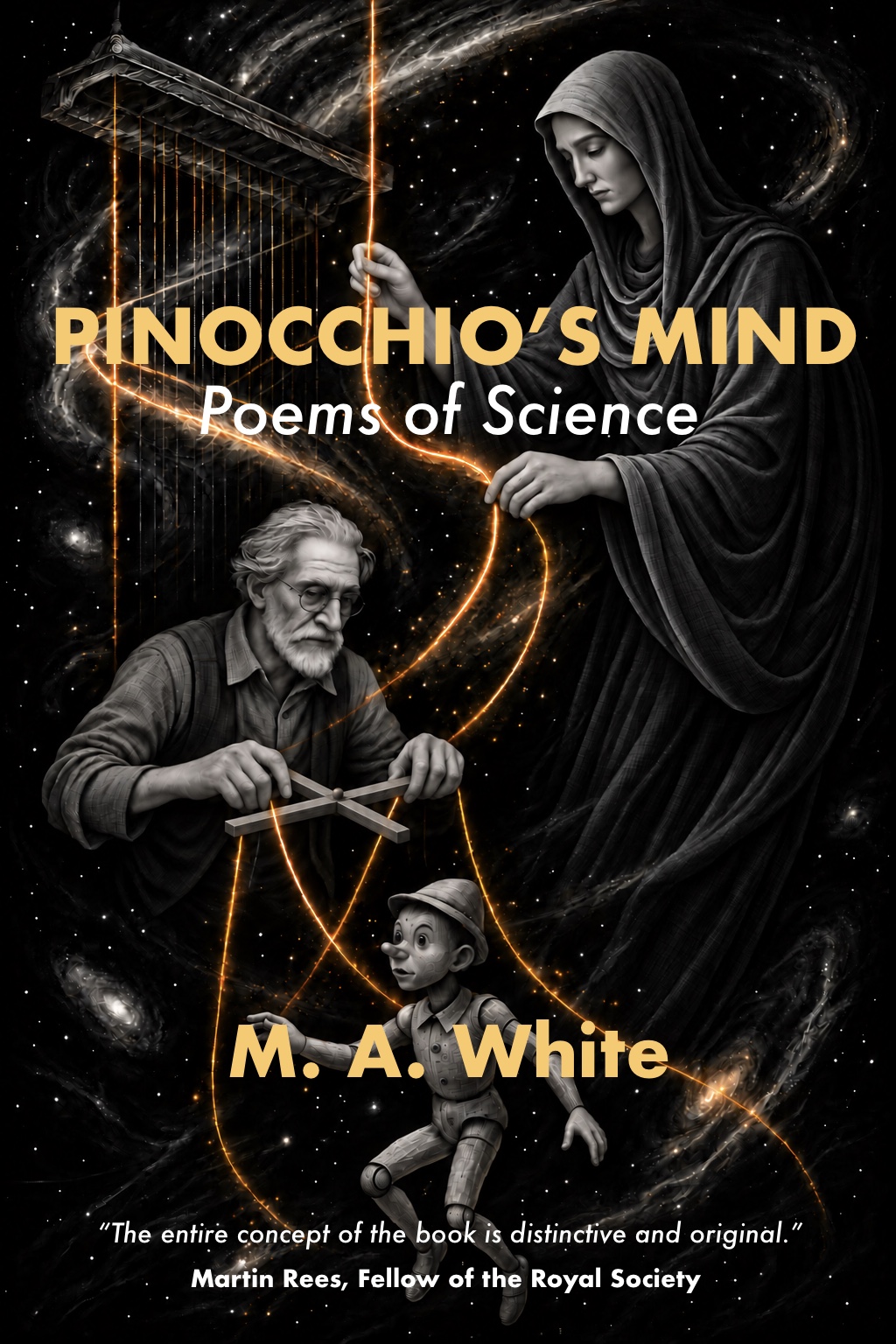
A work not by design but by descent
Pinocchio’s Mind is a popular science book given poetic form. A scientific experiment in poetry that rewrites the artistic assumptions of literary tradition for the scientific mind. Giving voice to scientists as humans and as humanists, these poems speak not merely about science, but of science.
As a method of asking.As a means of living.As a mode of being.
Borrowing its logic from the Periodic Table of Chemical Elements, the collection is structured as “The Poetic Table of Elements”: forty-three poems grouped into nine thematic “Periods”.
Situates the conceptual groundwork of the collection in the impulse to strip ideas down to their axioms and rebuild from observation and honest doubt.
Examines how biology, culture, and language shape the meanings we attach to ourselves and to other species.
Magnifies the field, offering new views on humanity’s search for order and meaning in a deterministic universe.
Asks what survives when memory is erased—whether from ancient scrolls or modern screens.
Spans the extreme scales science compels us to confront, guided by an expert in allometry—Lewis Carroll’s Alice.
Opens the STAFF ONLY door to reveal the everyday materials and methods of science, from impersonal procedures to personal experiences.
Charts the formation of the Solar System and anatomises the human body to excommunicate the notion of divine design.
Explores humanity’s relationship with the likelihood—and unlikelihood—of other life in the universe.
Raises a glass to mischief, mortality, and memoir—because discoveries aren’t only made in laboratories.
Each Period and each poem is paired with a reflective commentary and a companion illustration, extending the scientific context of the verse through further exposition and reflection.
The entire concept of the book is distinctive and original.
For me, Pinocchio’s Mind is a pioneering work: a book that expands the possibilities of scientific poetry and demonstrates that beauty need not be separated from precision, nor imagination from disciplined thought.
Sentience swells the anterior spine with architecture crazed and contorted; born a sceptic, the survivor survived this force of nature Nature selected.
With instinct infused, our parents we trust; the predator consumes another day, and talent, suffused, a child to corrupt, arouses the backbone to run away.
Flicking the switch between doubt and belief in altruistic genes for selfishness, the avenging angel of meaning seeks pattern recognition in purposelessness.
So the illusion of free will entwines Geppetto’s brain with Pinocchio’s mind.
The author was a Valentine’s baby, born on 28 February 1965, and has still to meet a deadline. Groomed by the State in the three ‘R’s required for cashing a giro, he attended finishing schools in Aberdeen and Warwick, flunking deportment and etiquette but acing zoology and genetics. With no ambition to work in a zoo, he found gainful employment at the University of Cambridge, labouring for gene and country as a bench technician in the fight against genetic disorders.
And then, one Thursday, he bought a one-way ticket to Japan. He now lives somewhere in the vicinity of Tokyo, 1.02 × 10⁻⁹ light-years from Brexit.